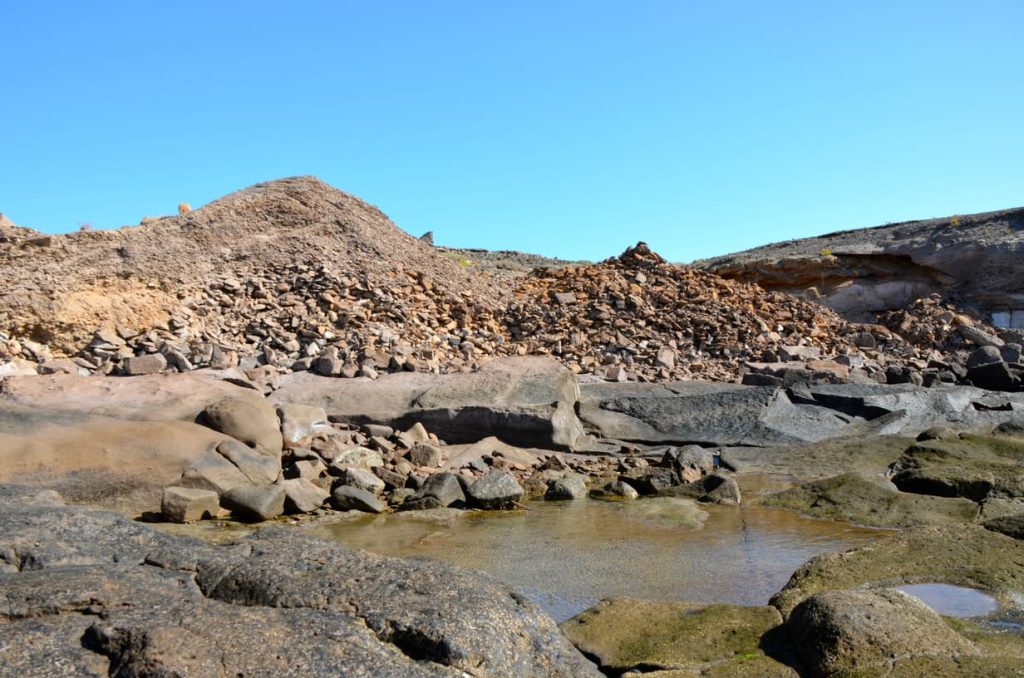
This place can be visited along a circular path of great ethnographic value that runs along the edges of the so-called Barranco de Bijagua ravine and which constitutes the so-called Museo de la Piedra de Arico (Arico Stone Museum). It can be reached from the centre of Tajao itself, heading N-NE along the coastal strip, as far as the mouth of this ravine (Caleta de La Lancha). You can identify it by the large stone totem poles that point the way and tell you the history of the place.
You will find an arid landscape, with a predominance of the typical plant formation of this coastal strip, dominated by the so-called Tabaiba dulce (Euphorbia balsamifera), of notable popular interest due to its various traditional uses. Along with it, we can also find other very common specimens such as: bitter tabaibas, cardones, cardoncillos, balos, etc.
You should know that you will be walking on surfaces of volcanic origin, fundamentally made up of the so-called pumitas or tosca blanca. The origin of this stone is quite curious, because it derives from the most explosive eruptive processes of our volcanism: the well-known ignimbrites or deposits of burning clouds (pumiceous tuff), emanating from the central and highest part of the island.
Since the 17th century and for at least three more centuries, the place of Caleta de La Lancha served as a shelter for the ships that sailed in coastal navigation and came here in search of the products of the quarries. These were anchored off the coast, approaching land in small barges or “chalanas”. The so-called Cueva de La Chalana was used to store one of these boats while waiting for the next load.
Nowadays, the “piedra de Arico” or “piedra chasnera” is still a local identifying feature. Traditionally extracted from its quarries in a traditional way, today it has become the product par excellence of very important extractive companies in the sector.
Points of interest to visit:
- Old well of Tajao.
- Old wharf of Bijagua.
- Surroundings of the old Cueva de la Chalana cave.
- Arch of Bijagua.
- Tabaibarril
- Old stone quarry from the 18th and 19th centuries. Translated with www.DeepL.com/Translator (free version)