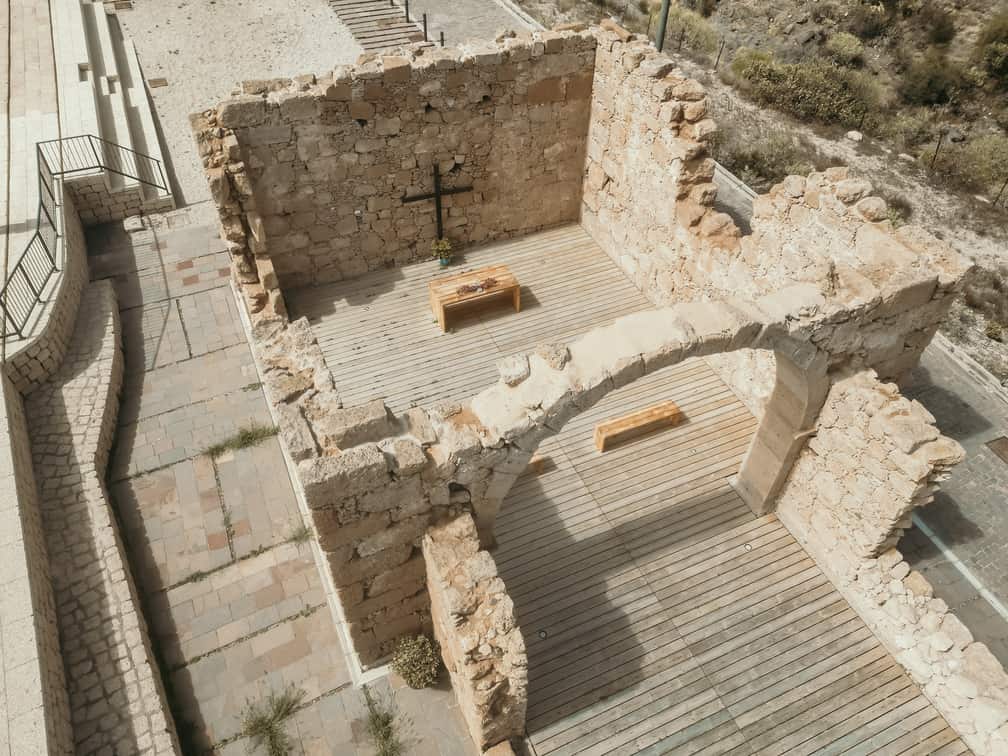
The Iglesia Vieja or Ermita de San Joaquín is located at the foot of the royal road and was built around the middle of the 17th century (1796), a time when the population centres that make up the current municipality of Fasnia were beginning to develop. Initially, the church consisted of a chapel with an almost square floor plan and a surface area of around 50 m2, with masonry walls built with local rough stone and a gabled tiled roof.
It is worth mentioning the round arch in stonework, erected in the thirties of the 18th century, when the main chapel was built, which even today, after almost three centuries, remains in good condition.
According to oral tradition, all the wood needed for the construction of the church (roof, door, windows, etc.) was obtained from a single centenary pine tree, the “giant pine of the Fasnia mountain”, located in a place that for that reason became known as “Pino de la Iglesia”. From 1796 to 1800 it was the first seat of the parish of San Joaquín and the first burial place for the deceased in its jurisdiction. Moreover, as it was the only public building that existed in the whole district, it was the only place where the Town Council meetings were held at that time, and in the square next to the chapel, the inauguration of the local corporations took place, in front of the whole town.
After the transfer of the parish to the new church in 1800, the deterioration of the old chapel began, and only 20 years later it was already in ruins, as in 1820 it was “abandoned”, without any services and roofless”, so its wood and roof tiles were used to build the new parish house. After this date, the old church only served as a burial place for five months in 1828, as a result of an epidemic that hit the place, until the inauguration of the first cemetery in the town. Time, neglect, wind erosion and rain eventually turned the solid structure into ruins. Today, only the front wall and one side of the main chapel and the arch that separates it from the old nave are still standing, while the side walls still retain part of the walls. These ruins were restored by the Town Hall in 1995, on the occasion of the bicentenary of the parish, and consolidated by the Cabildo in 1999; but the tropical storm knocked down the oldest wall of the first nave.
From its vantage point, it seems to contemplate the horizon. The semicircular arch of the chapel is still standing, resisting the constant winds that sway the town. Translated with www.DeepL.com/Translator (free version)